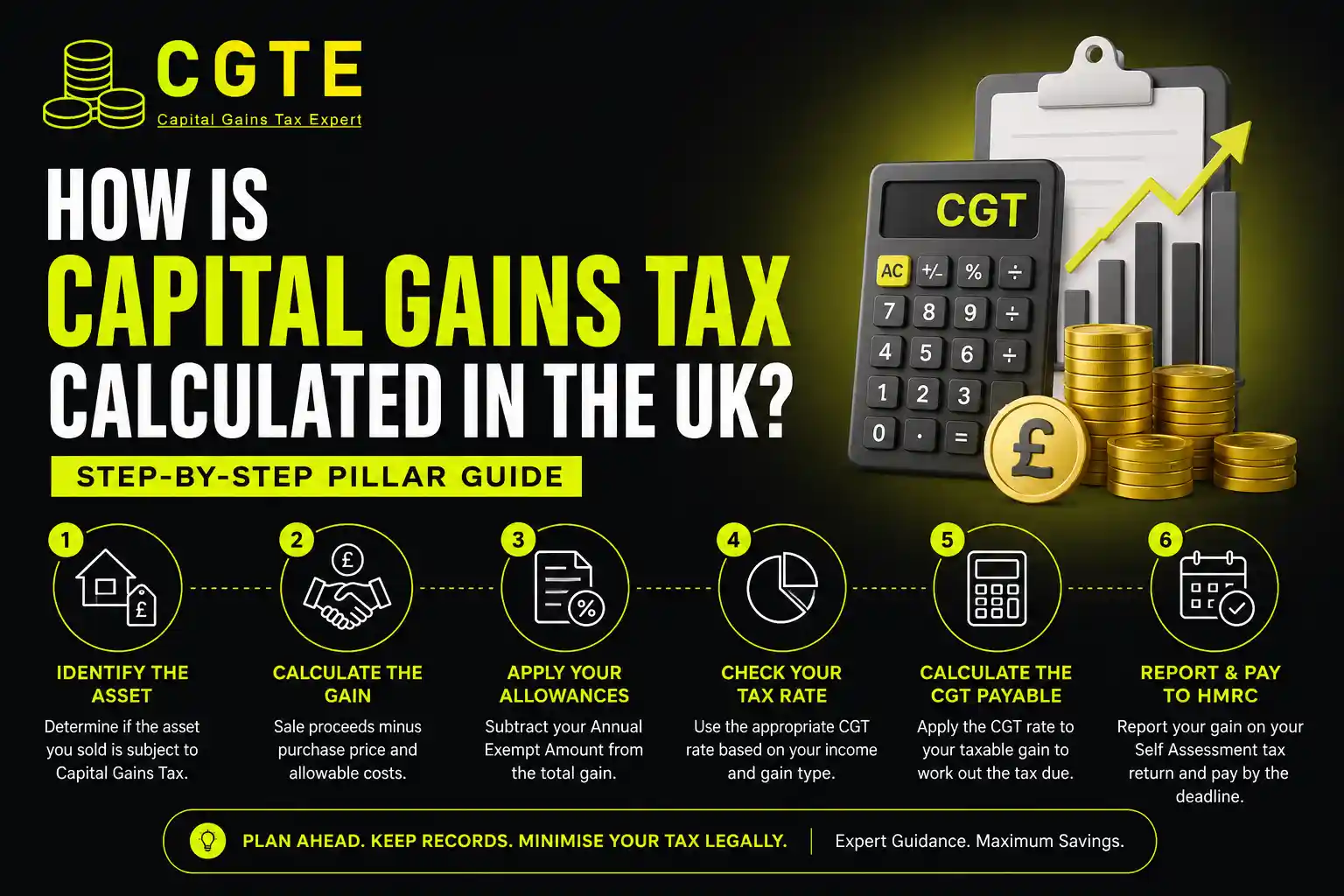
If you have ever sold a property, disposed of shares, or handed over a business asset, you already know the uncomfortable truth: HMRC does not care how hard you worked for that money. What it cares about is the gain. Understanding how is capital gains tax calculated UK wide is no longer a niche concern reserved for the wealthy it is a financial survival skill for every landlord, investor, and business owner operating in 2026/27.
With the annual exempt amount sitting at a historically low £3,000, and residential property gains taxed at rates of up to 24%, a single miscalculation can cost you thousands. This step-by-step pillar guide breaks down the exact HMRC-approved formula, covers every allowable deduction, and gives you the worked examples you need to check your own figures before filing.
How Is Capital Gains Tax Calculated UK? The Core Formula Explained
Capital gains tax is charged on your profit, not on the total amount you receive from a sale. The fundamental calculation always follows the same sequence, regardless of whether you are selling a second home, an investment portfolio, or a commercial property.
The calculation works as follows: start with your disposal proceeds, subtract your original acquisition cost, deduct your allowable purchase and sale expenses, deduct any capital enhancement expenditure, and you arrive at your gross chargeable gain. From that figure, subtract the annual exempt amount and any registered capital losses to reach your final taxable gain. Apply the correct percentage rate and you have your tax liability.
Put simply: Taxable Gain = Disposal Proceeds − (Acquisition Cost + Allowable Costs + Enhancement Expenditure) − Annual Exempt Amount − Carried Losses
This is the same approach used by HMRC and confirmed on the GOV.UK capital gains tax guidance page. Every legitimate tax-saving strategy builds on getting these individual components right.
Step 1 — Establish Your Disposal Proceeds and Base Cost
Your disposal proceeds is the value you receive when you sell, gift, or transfer an asset. In a straightforward commercial sale, this is simply the agreed purchase price. But HMRC applies specific rules for non-standard transactions that many taxpayers overlook.
Standard Market Sales
For open-market sales to unconnected parties, the disposal value is the actual sale price. Your base cost is everything you originally paid to acquire the asset including Stamp Duty Land Tax, legal fees, and survey costs paid at the point of purchase.
Gifts and Connected-Person Sales
When you gift an asset or sell it to a family member or business partner at below-market value, HMRC requires you to substitute the open market value at the date of disposal. This is a critical rule that catches many taxpayers off guard. You cannot use a nominal price of £1 to gift a property to a spouse and claim zero gain unless you are using interspousal transfer rules, which operate differently. Learn more in our detailed guide on gifting property to family and CGT implications.
Inherited Assets and Probate Value
If you have inherited a property or investment and are now selling it, your base cost is the open market value of the asset on the date of death not what the original owner paid for it. This probate value resets the cost base entirely, erasing any lifetime appreciation. For a detailed walkthrough, see our guide on how capital gains are calculated on inherited property.
Step 2 — Deduct Your Allowable Incidental Costs
Once you have established your gross profit, you can reduce it by deducting specific costs that HMRC recognises as directly related to the acquisition and disposal. These are known as allowable incidental costs, and they sit within the guidance published by the HMRC capital gains tax losses and costs page.
Allowable costs you can deduct include: conveyancing solicitor fees paid on purchase and sale; estate agent commissions and marketing costs; official survey and valuation fees required to establish probate or market value; Stamp Duty Land Tax or Land Transaction Tax paid at acquisition; and advertising costs spent specifically to attract a buyer.
Crucially, general maintenance, redecorating, and routine repairs cannot be deducted from your capital gain. These are revenue expenses that can only be offset against rental income on your self-assessment return. The line between a repair and an improvement is one of the most commonly misunderstood aspects of CGT, and getting it wrong directly inflates your tax bill.
Step 3 — Claim Capital Enhancement Expenditure
If you have spent money on permanent physical improvements to your asset not merely maintaining it you can deduct this expenditure from your gain. This is called enhancement expenditure, and it must meet three specific HMRC conditions:
- The work must create or restore an asset feature that adds lasting value beyond its original state
- The improvement must still be reflected in the condition of the asset at the time of disposal
- The work must not simply restore the asset to its original condition (that would be a repair)
Building a rear extension, converting a loft into a bedroom, installing a new bathroom where none existed, or adding a garage are all qualifying enhancement expenditures. Replacing a broken boiler with an equivalent model, re-laying a damaged roof, or repainting external walls are repairs and cannot be used to reduce your CGT liability.
Keeping thorough records of all capital works including invoices, planning permissions, and building regulations certificates is essential. HMRC can and does query these deductions during compliance checks. Our team at Capital Gains Tax Experts regularly works with landlords to compile decades of improvement records before a sale.
Step 4 — Apply the Annual Exempt Amount and Registered Losses
The 2026/27 Annual Exempt Amount
Every UK resident taxpayer receives a personal annual exempt amount a tax-free allowance that reduces their chargeable gain before tax is calculated. For the 2026/27 tax year, this stands at £3,000 for individuals and personal representatives, and £1,500 for most trustees.
This allowance cannot be carried forward. If you do not use it by 5 April 2027, it disappears. Strategic planning of disposal timing across two tax years especially for assets with large gains can therefore save you up to £720 in additional tax at the higher rate.
Offsetting Capital Losses
If you sell an asset at a loss in the same tax year, you must first offset that loss against gains realised in the same year before applying the annual exempt amount. Losses carried forward from previous years work slightly differently you only need to reduce your net gains down to the annual exempt amount level, not beyond it. You have four years from the end of the tax year in which a loss was realised to register it with HMRC.
Understanding how to use losses efficiently can significantly reduce your bill. Our guide on 8 legal ways to reduce capital gains tax on property covers loss harvesting alongside other planning strategies in detail.
Step 5 — Apply the Correct Capital Gains Tax Rate
Once you have calculated your final taxable gain, you need to identify which tax rate applies. The rate depends on two variables: the type of asset being disposed of, and where your gain falls relative to your income tax band.
For the 2026/27 tax year, the rates confirmed by HMRC are as follows:
- Basic rate taxpayers: 18% on residential property gains; 18% on shares, business assets, and other chargeable assets
- Higher and additional rate taxpayers: 24% on residential property; 24% on shares and other assets
- Trustees and personal representatives: 24% flat rate on all chargeable assets
To determine how much of your gain falls at each rate, you need to add your taxable income and your taxable capital gain together. Any portion that sits within the basic rate band (up to £50,270 combined income and gains) is taxed at 18%. Anything above that threshold is taxed at 24%.
For a deeper breakdown of who pays which percentage, read our complete guide to capital gains tax rates for 2026/27.
Worked Example: Residential Property Sale in 2026/27
To see how the five steps connect in practice, consider this realistic scenario:
An individual earns a salary of £30,000 and sells a buy-to-let property for £285,000 in 2026/27. They originally paid £200,000 for it. Legal and estate agent fees totalled £6,500. They built a rear extension for £15,000 during ownership. They have no carried capital losses.
Step 1 — Gross Gain: £285,000 − (£200,000 + £6,500 + £15,000) = £63,500
Step 2 — After Exempt Amount: £63,500 − £3,000 = £60,500 (taxable gain)
Step 3 — Rate Calculation: Their taxable income is £30,000 − £12,570 personal allowance = £17,430. The basic rate band holds £37,700, of which £17,430 is used by income. Remaining band: £37,700 − £17,430 = £20,270.
Step 4 — Tax Due: £20,270 at 18% = £3,648.60; £40,230 at 24% = £9,655.20. Total CGT: £13,303.80
This example illustrates how even a modest income can mean a substantial portion of a property gain is taxed at the higher 24% rate. Professional planning before completion not after is the only way to meaningfully reduce this figure.
CGT Rates and Allowances at a Glance: 2026/27
| Taxpayer Type | Residential Property | Shares & Other Assets | Annual Exempt Amount |
|---|---|---|---|
| Individual (Basic Rate) | 18% | 18% | £3,000 |
| Individual (Higher/Additional Rate) | 24% | 24% | £3,000 |
| Personal Representative (Estate) | 24% | 24% | £3,000 |
| Trustee of a Settlement | 24% | 24% | £1,500 |
The 60-Day Reporting Rule: What You Must Know
For UK residential property disposals, HMRC imposes a strict 60-day reporting and payment deadline. This starts from the date of completion not the date contracts are exchanged. Miss this window and you will face automatic late-filing penalties, regardless of whether any tax is actually owed.
Shares, commercial property, and non-residential assets do not fall under the 60-day rule. These are instead reported through your annual self-assessment tax return, due by 31 January following the tax year in which the disposal occurred.
If you have already missed the 60-day deadline, do not ignore it. Our guide on what to do if you’ve missed the 60-day CGT deadline sets out the penalties and how to remedy the situation before it escalates.
How Capital Gains Tax Experts Can Help You
Getting the calculation right is only half the challenge. The real opportunity lies in identifying every legitimate deduction, timing your disposals effectively, and structuring your assets in a way that legally minimises your exposure before a transaction completes.
At Capital Gains Tax Experts, we specialise exclusively in CGT planning and HMRC compliance. Unlike general accountancy firms, we do not split our attention between payroll, bookkeeping, and VAT returns. Every adviser on our team is focused entirely on helping clients reduce their capital gains tax liability through lawful planning strategies including interspousal transfers, Private Residence Relief optimisation, loss harvesting, and structured disposal timing.
Whether you are selling a second home, exiting a business, or managing a property portfolio, the right guidance at the right time can be the difference between a tax bill of thousands and a tax bill of tens of thousands. Speak with our team today and find out what is possible before you complete your next transaction.
For further authoritative guidance, the Low Incomes Tax Reform Group capital gains tax guide and the Chartered Institute of Taxation both publish independent analysis of current CGT rules.
Frequently Asked Questions About How Capital Gains Tax Is Calculated in the UK
How can I calculate my capital gains tax in the UK?
Start with your disposal proceeds, deduct your original acquisition cost, your allowable costs (legal fees, estate agent fees, SDLT), and any capital enhancement expenditure. The result is your gross chargeable gain. Subtract the annual exempt amount (£3,000 for 2026/27) and any registered losses. The remaining figure is your taxable gain. Apply 18% or 24% depending on whether you are a basic or higher rate taxpayer.
How much tax do I pay on capital gains in the UK?
In 2026/27, the CGT rate is 18% for basic rate taxpayers and 24% for higher and additional rate taxpayers, regardless of whether the asset is residential property or shares. Trustees and personal representatives pay a flat 24%. The rate that applies to you depends on your total income plus your gain relative to the higher rate income tax threshold of £50,270.
What is the 3-year rule for capital gains tax?
There is no universal “3-year rule” for capital gains tax in the UK. The rule some people refer to relates to Private Residence Relief specifically the final-period exemption, which was reduced to 9 months (not 3 years) for most property owners. In certain cases involving disability or care home moves, a 36-month final period still applies. Always check current HMRC rules for your specific circumstances.
What is the 6-year rule on capital gains tax?
The 6-year rule is an Australian CGT concept that does not apply in the UK. UK capital gains tax has no general 6-year hold period. However, there is a 4-year window in which you must register capital losses with HMRC from the end of the tax year in which the loss was made. Do not confuse international CGT rules with UK legislation.
Can I avoid capital gains tax by reinvesting the proceeds?
In most cases, no. The UK does not operate a blanket CGT rollover for private residential property sales the way some other countries do. Business Asset Rollover Relief and Business Asset Disposal Relief exist for qualifying business assets, but selling a buy-to-let property and buying another does not defer or eliminate the tax. Strategic planning through pension contributions, annual allowance use, and interspousal transfers offers more practical routes to reducing liability.
Do I pay capital gains tax when I sell an inherited property?
You may pay CGT if the property has increased in value since you inherited it. Your starting cost base is the probate value at the date of death. If you sell for more than that probate value — after deducting allowable costs — you have a chargeable gain. Read our detailed guide on CGT when selling an inherited property for a full breakdown.
What to Do Next
Tax rates are frozen. Allowances are shrinking. And HMRC’s compliance activity is increasing year on year. If you are planning a significant disposal in the 2026/27 tax year whether property, shares, or a business the time to act is before you complete, not after. The window for effective planning closes the moment you exchange contracts.
Book a consultation with Capital Gains Tax Experts today and get a clear, jargon-free assessment of your exact position.
We will identify every deduction you are entitled to, check whether any relief applies to your specific situation, and make sure your return is submitted correctly and on time.