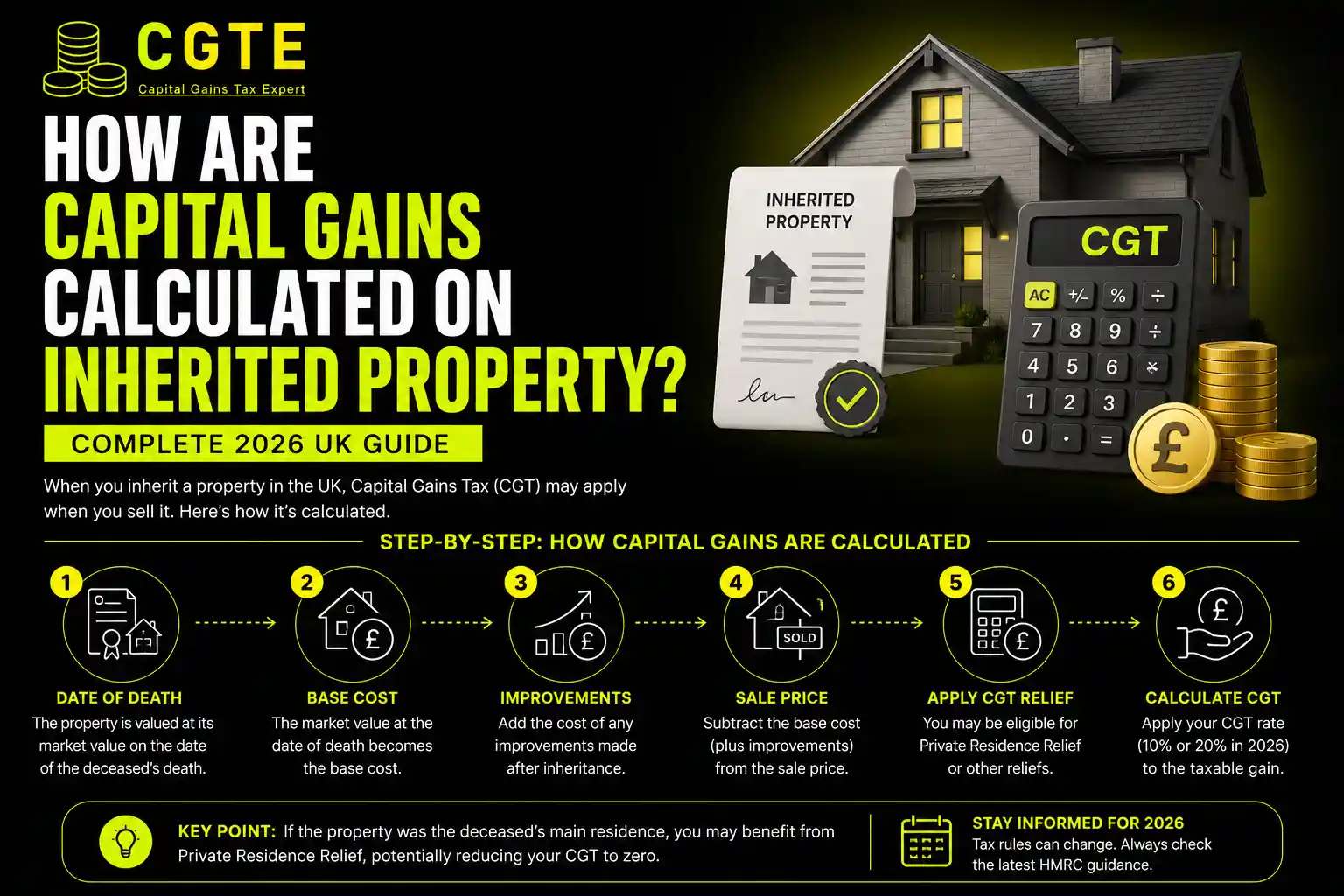
Probate values are the cornerstone of how are capital gains calculated on inherited property in the UK and most beneficiaries get this wrong. When a property passes to you through an estate, HMRC resets the base cost to the open market value at the date of death. That single mechanism is what makes inherited property so different from every other asset you might sell. You do not inherit the original purchase price your parent or relative paid decades ago. You inherit the valuation used for probate, and that becomes your starting point for every calculation that follows.
For the 2026/27 tax year, the rules on how are capital gains calculated on inherited property remain unchanged. The rate is 18% for basic rate taxpayers and 24% for higher and additional rate taxpayers applied to the gain between the probate value and your eventual sale price, after allowable deductions and the £3,000 annual exempt amount. But the maths only works in your favour if the probate value was established correctly in the first place. An undervalued probate figure leads to a larger taxable gain; an overvalued one means you have paid unnecessary inheritance tax. Getting both right simultaneously requires care.
This guide walks you through the complete process: how probate value is established, what deductions are permitted, how the CGT calculation works with a real example, and what legitimate planning strategies can reduce your liability before you complete a disposal.
How Are Capital Gains Calculated on Inherited Property: The Core Mechanism
When you inherit a property in the UK, HMRC’s rules on inherited property CGT set out a clear process. The estate obtains a probate valuation at the date of death, which becomes your acquisition cost. When you later sell the property, your taxable gain is the difference between the sale proceeds and this probate value, minus any allowable costs.
The formula for how are capital gains calculated on inherited property is:
Taxable Gain = Sale Price – Probate Value – Allowable Costs – Annual Exempt Amount
Allowable costs include:
- Solicitor and conveyancer fees on both acquisition and disposal
- Estate agent fees on sale
- Costs of any capital improvements (not maintenance or repairs)
- HMRC CGT return filing costs
Once you have the taxable gain, you apply the CGT rate based on your total taxable income in the tax year of disposal. For residential property, the rates for 2026/27 are 18% (basic rate band) and 24% (higher rate band). According to MoneyHelper’s guidance on CGT and inherited property, the most common error is failing to account for the split-rate calculation when a gain straddles both tax bands.
Step-by-Step: How Are Capital Gains Calculated on Inherited Property
Understanding exactly how are capital gains calculated on inherited property requires working through each stage in sequence. Here is the complete process:
Step 1 — Establish the Probate Value
The probate value is the open market value of the property at the exact date of death. This is not the purchase price the deceased originally paid, nor is it a retrospective estimate. It must reflect what a willing buyer would have paid in the open market on that specific date. A RICS-qualified surveyor is typically instructed to provide this valuation. If HMRC subsequently challenges it (within 4 years), you may need to provide supporting evidence of comparable sales.
Step 2 — Add Any Allowable Acquisition Costs
If you incurred costs in establishing your ownership such as solicitor fees relating to the grant of probate or transferring the property into your name these can be added to the base cost. Legal costs of administering the estate are generally allowable; funeral costs and general executorship fees are not.
Step 3 — Calculate the Sale Proceeds
The sale proceeds are the price you receive from the buyer, less any disposal costs. Disposal costs that are allowable include estate agent commission, legal fees on sale, and EPC costs incurred specifically for the sale.
Step 4 — Deduct Allowable Improvement Costs
Capital improvements made during your period of ownership such as a loft conversion, extension, or new kitchen are deductible. Routine maintenance, redecoration, and repairs are not allowable even if they increased the property’s value.
Step 5 — Apply the Annual Exempt Amount
For 2026/27, the Capital Gains Tax annual exempt amount is £3,000 per individual. If the property is jointly inherited (for example, by two siblings), each owner can apply their own £3,000 allowance against their share of the gain. This is a significant advantage of joint ownership structures.
Step 6 — Apply the Correct CGT Rate
The rate depends on your total taxable income (employment income, rental income, pensions, dividends) in the year of disposal. If your income leaves remaining basic rate band, the portion of your gain that falls within it is taxed at 18%. Any gain exceeding the higher rate threshold (£50,270 combined income and gain) is taxed at 24%.
Worked Example: CGT on an Inherited Property Sale
Here is a concrete illustration of how are capital gains calculated on inherited property in practice:
| Item | Amount |
|---|---|
| Probate value (date of death valuation) | £280,000 |
| Sale price achieved | £375,000 |
| Estate agent fees (1.5%) | -£5,625 |
| Solicitor fees on sale | -£1,800 |
| Loft conversion (capital improvement) | -£18,000 |
| Annual exempt amount | -£3,000 |
| Taxable Gain | £66,575 |
If the beneficiary has £35,000 of employment income, the basic rate band remaining is £50,270 – £35,000 = £15,270. CGT calculation:
- £15,270 @ 18% = £2,748.60
- £51,305 @ 24% = £12,313.20
- Total CGT liability: £15,061.80
Had the beneficiary also made pension contributions of £10,000 before the disposal, the basic rate band would have expanded to £25,270, reducing the 24% portion substantially saving approximately £1,800 in tax. This is why pre-disposal planning is essential. Our guide on how to reduce capital gains tax on property covers these strategies in depth.
Residential Property CGT and the 60-Day Reporting Rule
Knowing how are capital gains calculated on inherited property is only half the battle you also need to report and pay within the legal deadline.
When you sell an inherited residential property that generates a CGT liability, you must report and pay the tax within 60 days of completion. This applies regardless of whether you are required to file a Self Assessment tax return. Missing this deadline triggers automatic late filing penalties and interest. The Low Incomes Tax Reform Group’s guidance on CGT and property is a useful independent reference on the 60-day reporting obligation.
If you have already missed the 60-day deadline, do not delay further. Voluntary disclosure to HMRC can reduce penalties significantly. Our dedicated guide on missed CGT 60-day deadline penalties and solutions outlines your options.
What Happens When Multiple Beneficiaries Inherit?
When a property is inherited by two or more people for example, siblings or co-beneficiaries each person owns a proportionate share and is assessed for CGT on their individual share of the gain. This means each person can apply their own £3,000 annual exempt amount, and each person’s income tax position is assessed separately when applying CGT rates.
If one sibling is a basic rate taxpayer and another is a higher rate taxpayer, the combined CGT liability is often lower than it would be for a single higher-rate owner. This makes the sale of jointly inherited property a planning opportunity that is frequently overlooked. See our detailed analysis on whether you pay CGT when selling an inherited property for a full breakdown of joint ownership scenarios.
For joint owners considering whether to retain or sell, Hargreaves Lansdown’s overview of CGT on inherited property provides a useful investor-focused perspective alongside official guidance.
Private Residence Relief on Inherited Property
If you move into an inherited property and use it as your main home before selling, you may qualify for Private Residence Relief (PRR), which can eliminate some or all of the CGT charge on periods of owner-occupation. The relief applies proportionately: the periods you lived in the property as your main residence are exempt, while periods when it was rented out or left vacant are taxable (with a 9-month final period exemption).
If you are wondering how are capital gains calculated on inherited property when you have moved in as your main home, the answer is that PRR planning is particularly relevant for beneficiaries who move into the inherited property, renovate it, and then sell. The combination of a higher probate value, allowable improvement costs, and PRR can substantially reduce or eliminate the CGT bill. Our guide on how to avoid capital gains tax on inherited property in the UK sets out the full PRR strategy in detail.
Gifting an Inherited Property Instead of Selling: CGT Implications
If you choose to gift an inherited property to a child, sibling, or other family member you are treated as having disposed of it at market value on the date of the gift, regardless of whether any money changes hands. This means CGT is calculated as if you had sold it at its current market value, not at the value at which you give it away. The Ross Martin Tax guidance on gifts and CGT provides a detailed technical analysis of this treatment.
One important exception: if you are married or in a civil partnership, you can transfer an inherited property to your spouse or civil partner without triggering CGT, at no gain/no loss. This allows you to restructure ownership before a future sale. Read more about gifting property to family and CGT rules for a complete guide.
How Are Capital Gains Calculated on Inherited Property: 7 Common Errors to Avoid
In our experience working with beneficiaries selling inherited properties, the following errors cause the most problems:
- Using the original purchase price as the base cost — The deceased’s purchase price is irrelevant. Only the probate value matters.
- Failing to include all allowable improvement costs — Beneficiaries frequently forget loft conversions, extensions, or new heating systems they funded after inheritance.
- Missing the 60-day reporting window — The penalty regime is automatic and starts from day 61 after completion.
- Not splitting ownership to use both annual exempt amounts — Joint disposal doubles the allowance from £3,000 to £6,000.
- Ignoring income tax position in the disposal year — Selling a property in a low-income year (e.g., after retirement) can shift more gain into the 18% band.
If you are unsure whether you have calculated the gain correctly, a specialist review is far cheaper than an HMRC investigation. Our capital gains tax specialist service can review your calculation and confirm accuracy within 24 hours.
Frequently Asked Questions: How Are Capital Gains Calculated on Inherited Property
Do I pay capital gains tax if I sell an inherited property in the UK?
Yes, if you make a gain when you sell an inherited property, capital gains tax is payable on the profit. However, you do not pay CGT at the point of inheritance only when you subsequently dispose of the property. The gain is calculated from the probate value (the open market value at the date of death), not the original purchase price. If the property has gone down in value since the date of death, there is no CGT liability.
How is capital gains tax calculated on an inherited property?
The taxable gain on an inherited property is calculated as: sale price minus probate value, minus allowable selling costs, minus any capital improvement costs incurred during your ownership, minus the £3,000 annual exempt amount. The resulting figure is taxed at 18% if it falls within your basic rate band, or 24% if it exceeds the higher rate threshold. You must report and pay any CGT within 60 days of completing the sale.
What capital gains do you pay on an inherited property?
The CGT rate on an inherited residential property is 18% for basic rate taxpayers and 24% for higher and additional rate taxpayers in 2026/27. Personal representatives of an estate pay 24% on all gains (no split-rate applies). If the property has been your main home since inheriting it, Private Residence Relief may reduce or eliminate the CGT charge entirely.
What is the 3 year rule for capital gains tax?
The “3-year rule” is sometimes referenced in connection with HMRC’s ability to review probate valuations. HMRC can enquire into a probate valuation for up to 4 years after the grant of probate, or up to 6 years if there is a suspicion of deliberate undervaluation. There is no specific 3-year exemption from CGT on inherited property in UK law any such rule would apply only in the jurisdiction where it originated.
Can I avoid capital gains tax on an inherited property in the UK?
You cannot avoid CGT entirely if you sell an inherited property at a profit, but there are legal ways to reduce the liability significantly. Moving into the property as your main home gives access to Private Residence Relief. Making pension contributions before selling extends the basic rate band. Transferring to a spouse ensures a no gain/no loss disposal. Splitting ownership between two people doubles the annual exempt amount. Our free CGT consultation can identify which strategies apply to your situation.
Expert Support for Inherited Property CGT
Calculating how are capital gains calculated on inherited property correctly requires care at every stage from ensuring the probate value was accurate, to identifying all allowable costs, to timing the disposal in the most tax-efficient year. A single planning decision made before exchange of contracts can be worth thousands of pounds.
Our team of capital gains tax specialists works exclusively with beneficiaries, landlords, and property investors dealing with complex disposals. Whether you need a calculation review, pre-sale planning advice, or help submitting the 60-day CGT return, we can help. For an introduction to how property gains are assessed across different scenarios, read our pillar guide on how capital gains tax is calculated in the UK. When you are ready for personalised advice, book a free CGT consultation with our team today.