Skip links
Perrys vs Halliday Styan comparison

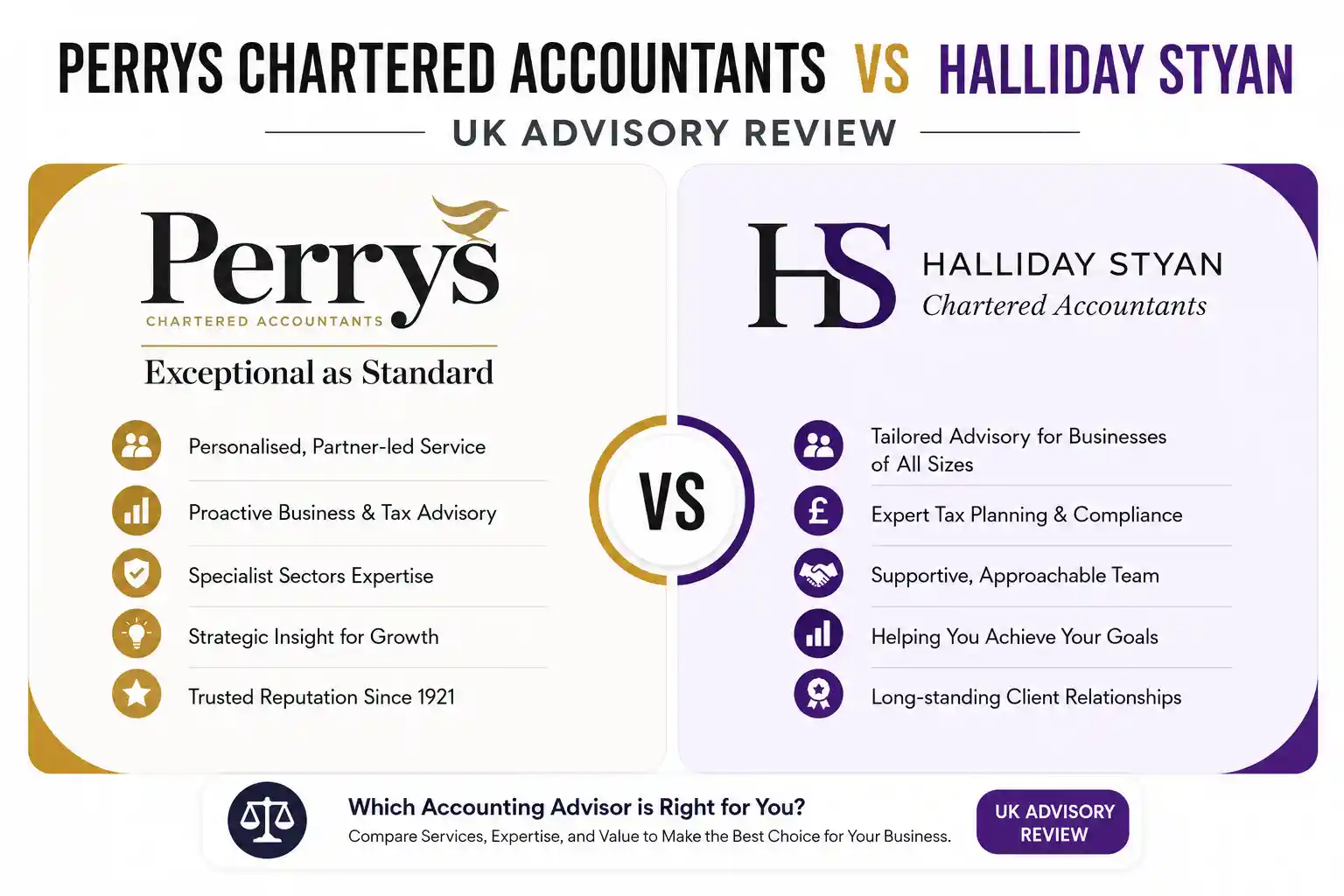
Perrys Chartered Accountants vs Halliday Styan Chartered Accountants: UK Advisory Review


If you are comparing Perrys Chartered Accountants vs Halliday Styan Chartered Accountants, you are already asking the right question. Choosing the wrong accounting firm costs UK businesses and property investors far more than just money it costs them time, missed tax reliefs, and compliance risk. According to ICAEW’s Business Confidence Monitor, over 40 percent of growing businesses struggle directly because of inadequate financial advisory support and poor cash flow management.

Both Perrys Chartered Accountants and Halliday Styan Chartered Accountants are established UK firms with strong reputations but they serve fundamentally different client profiles. One is built for scale, corporate complexity, and multi-office delivery. The other is built for personal partner access, pricing transparency, and strategic management reporting for growing businesses and charities.

Getting this decision wrong means either overpaying for services you do not need or, worse, working with a firm that lacks the depth to handle your specific financial situation. This guide cuts through the marketing language to give you a clear, expert comparison of both firms including who each firm is genuinely best suited for and when neither is the right option.

If your situation involves a significant asset disposal, property sale, or high-value wealth transfer, you may need something neither firm offers: a dedicated capital gains tax specialist. We will cover this in detail below.

Why Choosing the Right Accounting Model Matters in 2026

The UK tax landscape in 2026 is more demanding than at any point in the past decade. With capital gains tax rates on residential property sitting at 18 percent for basic rate taxpayers and 24 percent for higher rate taxpayers, the gap between good advice and average advice is measured in tens of thousands of pounds. Similarly, the 60-day CGT reporting deadline for UK property sales continues to catch unprepared clients off guard, with HMRC penalties accumulating rapidly for late submissions.

Before diving into the firm-by-firm comparison, it is important to understand the key criteria you should use to evaluate any UK accounting firm:

  • Specialisation depth: Does the firm have genuine expertise in your specific area, or are they a generalist practice covering everything at a surface level?
  • Partner access: Will you work directly with experienced senior advisers, or will your file be handled by junior staff?
  • Pricing transparency: Can you understand what you will pay before you commit, or are fees hidden behind vague quotation processes?
  • Tax planning capability: Does the firm offer proactive tax planning, or do they simply file what you have already done?
  • Sector knowledge: Does the firm understand your industry, whether that is property investment, charity management, or corporate M&A?

With these criteria in mind, let us examine how Perrys Chartered Accountants and Halliday Styan Chartered Accountants compare in detail. If you would like to explore whether a capital gains tax specialist is the right fit for your situation, you can also contact our team directly for a no-obligation discussion.

Core Philosophies — Scale and Breadth vs Personal Partner Involvement

The most important difference between these two firms is not their fee structures or their service lists — it is their fundamental philosophy about what an accountant should be for a client.

The Full-Service Business Advisory Model of Perrys Chartered Accountants

Perrys Chartered Accountants was founded in 1983 and has grown over four decades into a multi-office practice serving businesses, individuals, charities, and corporate groups across the UK. Their positioning as a full-service business adviser means they operate across the entire financial lifecycle of their clients, from startup formation through to complex corporate exits and estate planning.

Perrys’ model is built around institutional depth. Their core service areas include:

  • Complete corporate audit and assurance services for businesses above statutory thresholds
  • Mergers, acquisitions, and corporate finance advisory including valuations and due diligence
  • Succession planning and structured business exits
  • Comprehensive inheritance tax planning and trust structuring
  • Company secretarial, payroll, and bookkeeping services
  • Specialist charity accounting and statutory audit for larger non-profits

This approach treats tax compliance as one component of a broader commercial relationship. The firm’s size and resource depth allow it to tackle complex, large-scale corporate projects. This model suits established companies, medium-to-large enterprises, and high-net-worth individuals with diverse financial structures who need a single firm capable of handling multiple disciplines simultaneously.

The trade-off is accessibility. In larger multi-office practices, it is common for clients to work primarily with senior managers or associates rather than with the founding partners directly. For straightforward compliance work, this is entirely functional. For clients who want a senior adviser actively shaping their strategy, this structure can feel impersonal.

The Personal, Advisory-Led Model of Halliday Styan Chartered Accountants

Halliday Styan Chartered Accountants operates as a modern, partner-led practice built specifically around accessibility, pricing transparency, and practical business intelligence. The firm targets startups, owner-managed businesses, charities, freelancers, contractors, and growing SMEs that need more than compliance they need strategic guidance delivered by people who understand their specific situation.

Halliday Styan’s model concentrates on:

  • Meaningful management reporting and real-time cash flow forecasting
  • Helping business owners interpret and act on their financial performance data
  • Direct and consistent access to senior founding partners throughout the engagement
  • Streamlined communication without the corporate layers found in larger practices
  • Transparent starting fee structures published directly on their website
  • Dedicated charity sector support including SORP compliance and trustee reporting

This advisory-led model treats accounting not merely as a statutory obligation but as a live tool for better business decisions. For directors and entrepreneurs who value direct access to experienced, senior advisers who know their accounts intimately, this partner-led structure is genuinely attractive. The limitation is that the firm’s smaller footprint means it may lack the specialist depth for complex corporate transactions, statutory audits, or high-value capital events that require a dedicated specialist team.

Tax Advisory Depth and Execution

There is a critical distinction between standard tax filing and genuine tax planning. Standard compliance involves recording and reporting what has already happened. Advanced tax planning involves structuring transactions before they occur to legally minimise the final bill. This is where the capabilities of your accounting firm have the greatest financial impact.

Strategic Tax Planning at Perrys Chartered Accountants

Perrys Chartered Accountants‘ breadth of experience across audits, acquisitions, succession planning, and inheritance tax structuring positions the firm well for complex, multi-dimensional tax planning engagements. When a business prepares for significant growth, restructuring, or ownership transition, having access to an established corporate finance team with multi-disciplinary expertise adds real value.

Perrys can assist with tax-efficient transaction structuring during mergers, valuations during business sales, and strategic estate planning for high-net-worth clients. Their experience across a wide range of business sizes and sectors means they are equipped to handle the regulatory complexity that comes with larger financial events. For more on how specialist advice compares to generalist accounting, see our guide on whether you should use an accountant for capital gains tax.

Management Reporting and Analytical Advisory at Halliday Styan Chartered Accountants

Halliday Styan’s primary value proposition in tax advisory is the integration of tax planning with real-time business intelligence. Rather than approaching tax as a year-end exercise, the firm uses management accounts and forecasting tools to help clients make proactive financial decisions throughout the year.

This approach means clients receive:

  • Regular management accounts that highlight emerging tax planning opportunities
  • Cash flow projections that account for expected tax liabilities
  • Year-round access to senior advisers who understand the client’s full financial picture
  • Proactive alerts when tax thresholds or reliefs become relevant to the client’s situation

For growing owner-managed businesses, this integrated model can identify tax savings throughout the year that a reactive compliance service would miss entirely. However, when the tax event is a capital asset disposal particularly residential property, shares, or a business exit neither Perrys nor Halliday Styan offers the level of capital gains tax specialisation that a dedicated specialist firm provides. You can understand what specialist CGT planning involves by reading our article on how a capital gains tax specialist can save you money.

Fee Structures and Pricing Transparency

Accounting fees are a significant business expense, and understanding what you will pay before committing to a firm is an important part of the decision-making process. The two firms take fundamentally different approaches to pricing.

I. Fixed-Fee Transparency with Halliday Styan Chartered Accountants

Halliday Styan Chartered Accountants publishes starting prices for many of their core services directly on their website. This level of transparency is rare among UK chartered accountancy practices and provides immediate value to smaller businesses and startups that need to manage their professional fee budgets carefully. The ability to review indicative fees before arranging a consultation allows potential clients to self-select based on their budget parameters without wasting time on exploratory meetings.

For sole traders, freelancers, and early-stage SMEs, this pricing model removes a significant barrier to entry. It also signals the firm’s confidence in their value proposition and their commitment to straightforward client relationships. According to the Financial Reporting Council, transparency in professional services pricing is increasingly considered a marker of ethical practice and client-first advisory culture.

Customised Quotations with Perrys Chartered Accountants

Perrys Chartered Accountants uses a customised quotation model, tailoring their fee proposals to the specific needs, complexity, and scope of each engagement. While this approach is less immediately transparent, it is appropriate and often necessary for clients with complex corporate structures, multi-entity groups, or large charitable organisations that cannot be served by standardised packages.

For established businesses and high-net-worth individuals whose requirements span multiple disciplines audit, tax planning, corporate finance, and estate structuring a bespoke engagement model is genuinely more accurate and ultimately fairer. The customised model also reflects the reality that complex advisory work involves variable time commitments that cannot be pre-costed without proper scoping.

For context on how accounting fees relate to capital gains tax work specifically, our guide on how much accountants charge for capital gains tax provides a detailed breakdown of typical fee ranges across different types of CGT engagements.

Sector Specialisation — Charity Accounting and Compliance

Both firms serve the charity and non-profit sector, but their capabilities differ in scope and focus. For charity trustees and non-profit directors, understanding these differences is critical, as compliance failures in this sector carry serious regulatory consequences under the Charity Commission.

I. Dedicated Charity Support with Halliday Styan Chartered Accountants

Halliday Styan Chartered Accountants has developed a particularly strong and detailed positioning within the charity and non-profit sector. The firm provides comprehensive guidance across the full spectrum of charity accounting requirements, including:

  • Statement of Recommended Practice (SORP) compliance for charities of all sizes
  • Detailed restricted fund accounting, allocation, and reporting
  • Independent examinations and trustee reporting for charities below the statutory audit threshold
  • Gift Aid administration, HMRC claims, and tax relief maximisation
  • Governance support and trustee financial literacy training

For small-to-medium charities and non-profits that require a knowledgeable, personally accessible advisor who understands the Charity Commission’s standards in depth, Halliday Styan’s positioning in this sector provides genuine reassurance.

II. Statutory Audit Capability with Perrys Chartered Accountants

For larger charities that exceed the statutory thresholds requiring a full independent audit currently set at gross income above £1 million or expenditure above £500,000 Perrys Chartered Accountants provides the registered audit services required by law. Their experienced audit department is equipped to ensure that large charitable organisations meet all statutory requirements, maintain administrative transparency for donors, and satisfy the scrutiny of the Charity Commission and other regulatory bodies.

The key distinction is that Halliday Styan’s charity expertise is primarily advisory and compliance-focused for small-to-medium organisations, while Perrys has the audit registration and departmental depth to serve larger charities that face statutory audit requirements.

Strategic Comparison Table

The following matrix summarises the key differences between Perrys Chartered Accountants and Halliday Styan Chartered Accountants to support your final evaluation.

Evaluation Criteria Perrys Chartered Accountants Halliday Styan Chartered Accountants
Primary Focus Corporate audits, acquisitions, and multi-office advisory Partner-led strategic forecasting and personal advisory
Pricing Structure Custom, tailored quotations based on complexity Transparent public starting rates for core services
Best Suited For Medium-to-large corporate groups and established firms Startups, owner-managed businesses, charities, and SMEs
Audit Capabilities Full registered corporate audit department Independent examinations and SORP compliance
Charity Sector Statutory audit for larger non-profits Dedicated SORP compliance and trustee reporting
Partner Access Departmental structure with specialist team leads Direct, ongoing access to senior founding partners
Tax Planning Depth Strong corporate and estate planning capability Integrated management reporting and proactive advisory
Capital Gains Tax General CGT support as part of broader advisory General CGT support within management advisory

When Neither Firm Is Enough — The Capital Gains Tax Specialist Alternative

There is a category of financial event for which neither Perrys Chartered Accountants nor Halliday Styan Chartered Accountants nor any generalist or multi-disciplinary firm is the optimal choice: high-value asset disposals involving significant capital gains tax exposure.

When you are selling a residential investment property, a buy-to-let portfolio, inherited property, a business, or a substantial share portfolio, the tax liability can reach 24 percent on your chargeable gain. At these rates, the difference between well-planned and poorly-planned disposals is frequently measured in five or six figures.

This is where Capital Gains Tax Experts provides a genuinely distinct alternative. Our practice focuses exclusively on CGT planning, relief optimisation, and HMRC compliance for UK individuals, landlords, and business owners. We do not offer bookkeeping, payroll, or general compliance services. Every resource we have is dedicated to ensuring you pay the minimum lawful amount of capital gains tax on every disposal.

Our specialist services include:

The fundamental formula for your CGT liability is straightforward:

Tax Liability = (Chargeable Gain − Annual Exempt Amount) × Applicable Tax Rate

What is not straightforward is the application of all available reliefs, deductions, and planning strategies that legally reduce your chargeable gain before this formula is applied. This is precisely where specialist advice generates its value. To understand whether you may be eligible for reliefs that could significantly reduce your CGT liability, our capital gains tax calculator provides a useful starting point.

We have helped hundreds of UK property investors, landlords, and business owners structure their disposals to reduce their CGT bills substantially and legally. You can read about specific relief strategies in our guides on how to reduce capital gains tax on property and how to avoid capital gains tax on inherited property in the UK.

If you are comparing Perrys Chartered Accountants vs Halliday Styan Chartered Accountants and your situation includes a significant property disposal or asset sale, we strongly recommend speaking with a dedicated CGT specialist before you proceed. To learn more about what our specialist team does and how we can help, visit our services overview page.

Frequently Asked Questions

What is the difference between an independent examination and a charity audit?

An independent examination is a less intrusive form of financial scrutiny permitted for smaller charities whose gross income falls below the statutory audit threshold (currently £1 million). A formal charity audit is a detailed statutory review conducted by a registered auditor, required for larger charities to provide absolute assurance to trustees, donors, and the Charity Commission. Halliday Styan is well-placed for independent examinations, while Perrys provides full registered audit services for charities requiring the latter.

How does pricing transparency benefit startups choosing an accountant?

When an accountancy firm publishes its starting fees openly, early-stage businesses can project their professional overheads accurately from the beginning. This allows founders to avoid unexpected costs and select a service level that matches their current cash flow parameters. Halliday Styan’s transparent fee structure is particularly valuable for pre-revenue or early-growth businesses operating within tight financial constraints.

Can a general accountant handle corporate mergers and acquisitions?

General compliance accountants can compile historical financial records, but complex M&A transactions require specialist corporate finance expertise including precise business valuations, tax-efficient deal structuring, legal due diligence, and negotiation support. Perrys Chartered Accountants has the corporate finance depth to support complex M&A engagements, while this falls outside the primary scope of Halliday Styan’s advisory model.

What are the capital gains tax implications when selling a business?

When selling a business, the proceeds may be subject to capital gains tax at rates of up to 24 percent, depending on the structure of the sale and your total income. However, qualifying business owners may be eligible for Business Asset Disposal Relief (BADR), which reduces the CGT rate to 10 percent on qualifying gains up to a lifetime limit of £1 million. Specialist advice is critical to ensure eligibility criteria are met before the disposal occurs. Our BADR calculator can provide an initial estimate of your potential saving.

Why is partner-led accounting valuable for owner-managed businesses?

In a partner-led practice, your financial affairs are supervised directly by highly experienced, senior advisers rather than being delegated to junior staff members. This improves communication quality, accelerates decision-making, and gives business owners direct access to the strategic guidance they need when facing complex financial decisions. For owner-managed businesses where the financial situation is closely tied to personal wealth planning, this continuity of senior engagement is a significant practical advantage.

When should I use a dedicated capital gains tax specialist rather than a general accountant?

You should engage a dedicated CGT specialist whenever you are planning to sell residential investment property, a business, inherited assets, or a substantial share portfolio particularly if the expected gain exceeds your annual exempt amount of £3,000. The complexity of CGT reliefs, the strict 60-day reporting deadline for property sales, and the significant rates involved (18 percent or 24 percent on property) mean that specialist advice consistently generates savings far exceeding its cost. Our article on whether you need an accountant for capital gains tax explores this question in depth.

Making the Right Choice for Your Financial Situation

The comparison between Perrys Chartered Accountants vs Halliday Styan Chartered Accountants does not produce a single winner it produces a clear picture of two different firms built for two different types of client.

Perrys Chartered Accountants is the stronger choice when you need:

  • Statutory audit services for a business or charity above the audit threshold
  • Corporate finance support for mergers, acquisitions, or structured business sales
  • Multi-disciplinary advisory across audit, tax, corporate finance, and estate planning simultaneously
  • A firm with the institutional scale to handle complex, multi-entity engagements

Halliday Styan Chartered Accountants is the stronger choice when you need:

  • Direct, ongoing access to senior founding partners who know your accounts in detail
  • Transparent, clearly communicated fee structures before you commit
  • Integrated management reporting and cash flow forecasting to support daily business decisions
  • A dedicated, advisory-led accountant for a startup, SME, or small-to-medium charity

Neither firm is the optimal choice when your primary challenge is a high-value capital gains tax event a residential property disposal, business exit, inherited asset sale, or share portfolio liquidation. In these situations, the depth of specialist CGT knowledge and the financial stakes involved require a practice that focuses exclusively on capital gains tax.

At Capital Gains Tax Experts, we work exclusively on CGT planning, relief optimisation, and HMRC compliance for UK individuals, landlords, and business owners. We have helped hundreds of clients legally reduce their capital gains tax liabilities and submit compliant returns on time. If you are facing a significant asset disposal, the smartest decision you can make is to get specialist advice before you proceed not after.

To explore your options and understand what specialist CGT planning could save you, contact our team today for a no-obligation consultation. You can also explore our full range of CGT services or use our free capital gains tax calculator to get an immediate estimate of your potential liability.

For further reading on related topics, explore our guides on capital gains tax for landlords, what is capital gains tax in 2026, and CGT wealth protection strategies for 2026.

GET A FREE CGT CONSULTATION