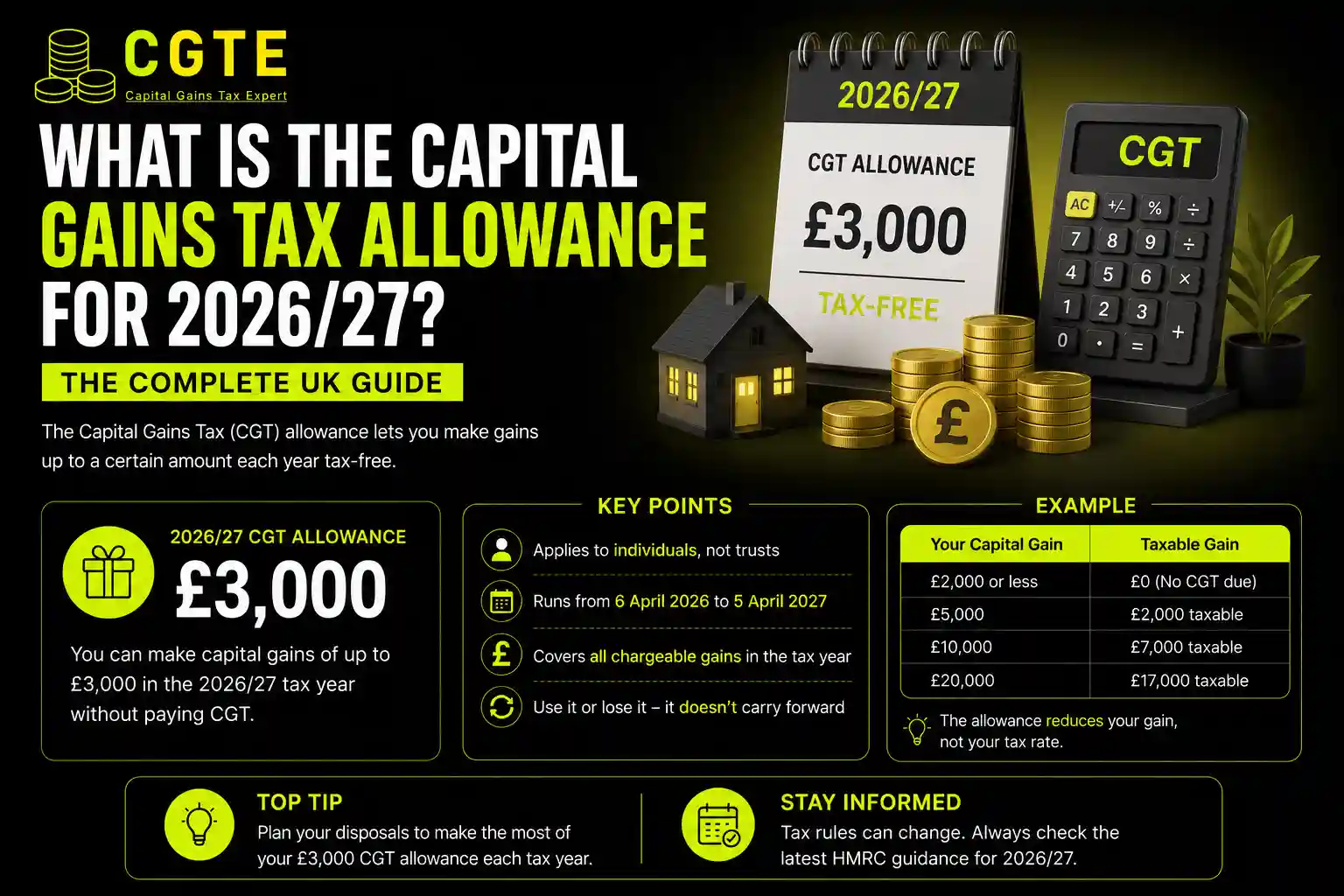
Something quietly radical happened to the UK tax system in April 2024 and millions of property owners, investors, and business sellers are still paying the price. The capital gains tax allowance 2026 stands at just £3,000 per individual, a figure that represents a 75% reduction from the £12,300 allowance available just three tax years ago. If you have not adjusted your disposal strategy to account for this change, you may be paying significantly more tax than you need to.
This guide covers everything you need to know about the CGT annual exempt amount for 2026/27: what it is, who it applies to, how it interacts with the tax rates, and which planning strategies actually work in today’s environment. We draw on the latest figures confirmed by HMRC and cross-reference them with guidance from professional bodies to give you an accurate picture before you make any financial move.
What Is the Capital Gains Tax Allowance for 2026/27?
The capital gains tax allowance 2026 is the annual exempt amount the maximum profit you can realise from the sale of assets in a single tax year before any capital gains tax becomes payable. For the 2026/27 tax year, this stands at:
- £3,000 for individuals, including sole owners and joint owners (each receives their own allowance)
- £3,000 for personal representatives administering a deceased estate (for up to three tax years from the date of death)
- £1,500 for most trustees of a settlement
This allowance is confirmed on the HMRC capital gains tax allowances page and remains unchanged from 2024/25. It applies to gains from residential property, shares, business assets, and personal possessions worth over £6,000.
The allowance works on a strict “use it or lose it” basis. If you do not utilise the full £3,000 before 5 April 2027, it disappears entirely. It cannot be carried forward, gifted, or transferred to a spouse though the asset itself can be transferred, which opens up important planning opportunities covered below.
How the Capital Gains Tax Allowance Has Changed Since 2022
To understand why the 2026/27 allowance feels so inadequate, you need to see the full historical picture. The reduction has been systematic and deliberate a stealth tax policy that has dramatically increased the CGT burden on ordinary taxpayers without any headline rate changes.
| Tax Year | Individual Allowance | Married Couple Combined | Trustee Allowance |
|---|---|---|---|
| 2022/23 | £12,300 | £24,600 | £6,150 |
| 2023/24 | £6,000 | £12,000 | £3,000 |
| 2024/25 | £3,000 | £6,000 | £1,500 |
| 2025/26 | £3,000 | £6,000 | £1,500 |
| 2026/27 | £3,000 | £6,000 | £1,500 |
The £3,000 individual allowance is the lowest it has been in over two decades. In practical terms, a property that has gained just £3,001 in value since you bought it will trigger a tax liability even after accounting for allowable costs. For landlords, second homeowners, and long-term investors, this creates a significant planning challenge on every disposal.
For further context on the trajectory of these changes, the Hargreaves Lansdown 2026/27 tax facts guide provides a comprehensive breakdown of current rates alongside the allowance figures.
How the Capital Gains Tax Allowance 2026 Interacts with Tax Rates
The allowance does not operate in isolation. Once your gains exceed £3,000, the tax rate applied depends on your total taxable income for the year. Under the current unified CGT framework confirmed by the HMRC rates page:
- Basic rate taxpayers pay 18% on chargeable gains (income plus gains below £50,270)
- Higher and additional rate taxpayers pay 24% on chargeable gains (income plus gains above £50,270)
- Personal representatives and trustees pay a flat 24% on all chargeable gains
Crucially, your income uses up the basic rate band first. If you earn £40,000 in salary, only £10,270 of the basic rate band remains for your capital gains. Any gain above that £10,270 (and above the £3,000 allowance) falls into the 24% bracket. At current rates, a £50,000 property gain for a standard-salary earner could easily trigger a five-figure tax bill much of it at 24%.
Our complete breakdown of capital gains tax rates for 2026/27 gives detailed examples of how this stacks up for different income profiles.
Strategies to Make the Most of the £3,000 CGT Allowance
1. Interspousal Transfers Before Disposal
Transfers between spouses or civil partners living together are executed on a “no gain, no loss” basis. This means you can transfer an asset or a share of it to your partner before selling, without triggering any CGT at that point. When the sale completes, each of you applies your own £3,000 allowance to your respective share of the gain, effectively doubling the tax-free threshold to £6,000 for the couple. If one partner is a basic rate taxpayer, their portion of the gain is also taxed at 18% rather than 24%.
This is one of the most powerful and widely underused strategies available. Our detailed guide on CGT rules for gifting assets to family members explains how to structure these transfers correctly.
2. Staggering Disposals Across Tax Years
If you are selling a portfolio of shares or are not under time pressure to complete a property sale, consider whether part of the gain can fall into the following tax year. By completing part of a share sale before 5 April and the rest after 6 April, each portion benefits from a separate £3,000 allowance saving up to £1,440 at the higher rate over two years.
3. Pension Contributions to Extend the Basic Rate Band
Making a personal pension contribution increases your basic rate band by the gross contribution amount. This can push your gain into the lower 18% rate or reduce how much sits at 24%. For higher earners with a significant gain pending, a single pension contribution of £10,000–£20,000 can save thousands in CGT while simultaneously building retirement wealth. This strategy is particularly useful for those selling a buy-to-let property. See how this connects with our guide on 8 legal ways to reduce capital gains tax on property.
4. Utilising Registered Capital Losses
If you have sold assets at a loss in this or previous tax years, those registered losses can offset your gains. Current-year losses must first reduce your gains to the annual exempt amount level; only carried-forward losses from prior years give you more flexibility in how deeply you apply them. If you have not registered losses with HMRC from past disposals, you have up to four years from the end of the relevant tax year to do so. For more detail on this, see our guide to how capital gains tax is calculated in the UK.
5. ISA Wrappers and Bed-and-ISA Strategies
Gains realised on assets held within a stocks and shares ISA are entirely free from CGT. If you hold investments outside an ISA, a “bed-and-ISA” operation selling assets outside the ISA and buying them back within it uses your CGT allowance now to shelter future gains. You cannot do this with a spouse’s account; it must be into your own ISA. The £20,000 ISA annual subscription limit applies.
The Capital Gains Tax Allowance on Inherited Property
When you inherit a property and later sell it, the capital gains tax allowance 2026 applies in the same way it does to any other asset. However, the starting cost base known as the probate value is the open market value of the property on the date of the original owner’s death, not what they originally paid for it.
This means if the property has risen in value since the date of death, that appreciation is your taxable gain, minus the £3,000 allowance and any allowable disposal costs. If the property has fallen in value since the date of death, you may have a loss to register. Our detailed guide on how capital gains are calculated on inherited property walks through this step by step.
How Capital Gains Tax Experts Helps You Maximise Your Allowance
There is a significant difference between knowing the rules and knowing how to apply them to your specific set of assets, income, and plans. The annual exempt amount is just one element of a broader tax planning framework. Getting it wrong or simply not planning consistently results in overpaying.
At Capital Gains Tax Experts, our team focuses exclusively on CGT planning and HMRC compliance. We identify every eligible deduction, advise on timing your disposals to use the allowance across multiple tax years, and structure interspousal transfers where appropriate. We do not handle payroll or VAT we exist solely to help you keep more of your investment gains.
For a broader view of tax rates and planning considerations relevant to 2026/27, the Interactive Investor CGT allowance guide and Association of Taxation Technicians 2026/27 update are both useful independent references.
Whether you’re planning a property sale, exiting a share portfolio, or winding down a business, understanding how the allowance works before you complete not after is the key to minimising your liability. Book a consultation with our team today using our free CGT consultation page.
Frequently Asked Questions About the Capital Gains Tax Allowance 2026
What will CGT allowance be from April 2026?
From April 2026 (the start of the 2026/27 tax year), the CGT annual exempt amount remains at £3,000 for individuals and personal representatives, and £1,500 for most trustees. There have been no announced changes to these figures for 2026/27. The allowance has been frozen at £3,000 since April 2024.
What is the CGT exclusion for 2026?
The CGT exclusion also called the annual exempt amount is £3,000 per individual for 2026/27. This means the first £3,000 of your net capital gains in the tax year is completely free from CGT. Gains above this amount are taxed at 18% (basic rate) or 24% (higher rate), depending on your total income.
How is capital gains tax calculated in 2026?
In 2026/27, you calculate CGT by: (1) taking your disposal proceeds; (2) subtracting the acquisition cost, allowable costs, and enhancement expenditure to get the gross gain; (3) deducting the £3,000 annual exempt amount and any registered losses; (4) applying either 18% or 24% depending on whether the remaining gain pushes your combined income and gains above the higher rate threshold of £50,270.
What are the changes in capital gains tax in 2026?
For 2026/27, the CGT rates remain at 18% and 24% unchanged from 2025/26. The annual exempt amount remains at £3,000 for individuals. There were no headline CGT changes announced for 2026/27. The major changes that impact current taxpayers were the rate increases in October 2024 (which aligned residential and non-residential property CGT rates) and the series of allowance cuts that brought the individual exemption from £12,300 down to £3,000 over three years.
Is the capital gains tax allowance transferable between spouses?
No, the allowance itself is not transferable. However, assets can be transferred between spouses on a no gain/no loss basis before a sale. Each spouse then uses their own £3,000 allowance against their share of the gain. This effectively doubles the tax-free amount for couples and is one of the most commonly recommended planning strategies before any major disposal.
Do I need to report a gain below the CGT allowance to HMRC?
If your total capital gains are below the £3,000 annual exempt amount and your total disposal proceeds do not exceed four times the allowance (£12,000), you generally do not need to report the sale. However, for residential property disposals, even if no tax is due, HMRC may still require a return within 60 days of completion. Always verify with a specialist before assuming no reporting is needed.
Take Action Before Your Next Disposal
The annual exempt amount of £3,000 is unlikely to be increased in the near future. With fiscal drag compressing basic rate bands and rising property values generating ever-larger gains, every UK taxpayer with investment assets needs a clear disposal strategy before they complete a transaction not after.
The difference between planning before and planning after can easily amount to thousands of pounds. Contact our CGT specialists to get a personalised assessment of how the 2026/27 allowance and rates apply to your specific assets, and what steps you can take right now to reduce your exposure legally.